
A1146: Special Status for One Group — Second-Class Free Speech for Everyone Else
Puts Islam Above Equal Protection — Contact Your Legislators Now
Read time 3-5 minutes
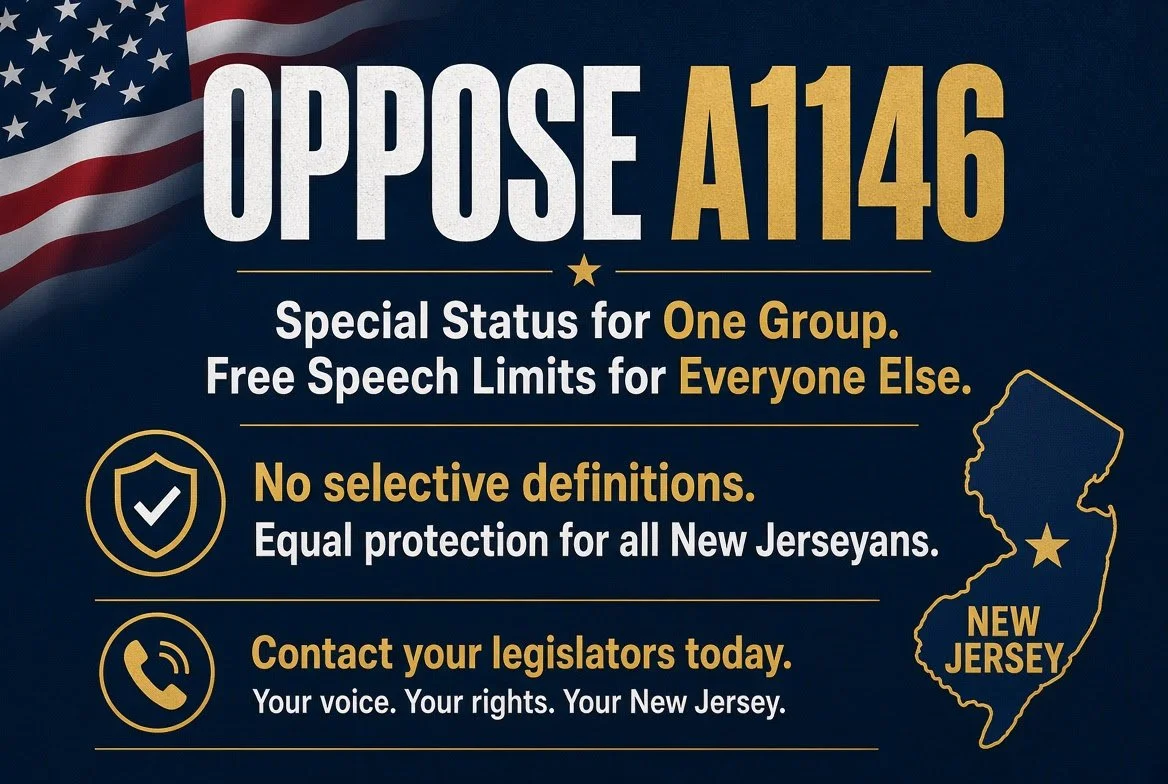
Assembly Bill A1146, currently pending in the New Jersey Legislature, sponsored by Assemblyman Joe Danielsen (District 17) and co-sponsored by several Democratic colleagues. This would establish the first official state definition of “Islamophobia” for use by public officials and law enforcement when assessing motive in civil and criminal discrimination or bias cases. It does not create a new crime, but it directs officials to consider a specific, expansive definition. This privilege is not extended to any other religious demographic in the state.
Assemblyman Joe Danielson is known as the bully of the New Jersey General Assembly. During an Assembly Public Safety and Preparedness Committee meeting, Assemblyman Paul Kanitra asked questions of the witnesses when Joe Danielson, in his usual vulgar manner, turned off Kanitra's microphone. During another committee hearing, Danielson started badgering Marie Tasey of New Jersey Right to Life while she was testifying. Reverend Gregory Quinlan of the Center for Garden State Families asked the chairperson, "Can we testify without being bullied?" These are just a couple of examples of Joe Danielsen's lack of professionalism and disrespect for colleagues and citizens expressing their concerns.
The bill defines Islamophobia as “a type of racism that targets expressions of Muslimness or perceived Muslimness.” Its examples include hostility and fear of Islam itself, “severe disparagement” of Muslim persons or their culture, claims of a demographic threat or “Muslim takeover,” accusations of dual loyalty to a transnational community or foreign countries, and holding Muslims collectively responsible for actions of individuals or Muslim-majority countries. The definition is modeled in part on a proposal from a British parliamentary group that the UK government ultimately rejected, citing free-speech and equality-law concerns and its subjectiveness.
Existing New Jersey law already prohibits religion-motivated crimes and discrimination against people of every faith. Our current law is inclusive and protects all citizens. A1146 adds an interpretive framework that reaches into viewpoint territory. Critics, including some Republican legislators, have noted that this approach risks treating legitimate discussion of Islamic doctrines, practices, political Islam, or demographic trends as evidence of bias. For communities with direct experience of religious persecution, the language raises particular concerns.
New Jersey is home to one of the largest Coptic Christian communities in the United States. Many Coptic Christians emigrated from Egypt, where the Christian minority has faced discrimination, church attacks including bombing & arson, killings, and pressures from governments influenced by Islamist movements. Similar histories exist among other Middle Eastern Christian communities. Classical and some contemporary interpretations of Islam include a theocratic political-legal dimension known as sharia. Criticism of those elements is not racial animus against individuals; it is commentary on ideas and systems. A definition that classifies “fear of Islam” or cultural critique as racism can chill speech that Copts and others regard as essential to their safety and to honest free speech. These discussions expose the realities of Islamic practices.
At the same time, antisemitism remains at historically elevated levels in New Jersey and nationally. According to the Anti-Defamation League, the state recorded 687 anti-Semitic incidents in 2025—third-highest in the nation—despite a modest decline from the prior year. Assaults rose, vandalism increased, and New Jersey led the country in incidents at K-12 schools. FBI data for recent years show Jews, roughly 2 percent of the U.S. population, accounting for 60–70 percent of religion-based hate crimes, far exceeding anti-Muslim incidents. Multiple bills to adopt the International Holocaust Remembrance Alliance (IHRA) working definition of antisemitism have been introduced in New Jersey with bipartisan support (including measures in the current session such as A617, S780, and AJR23). These efforts have repeatedly stalled. No comparable state definition exists for anti-Christian hatred, despite documented incidents against churches and Christians.
This selective approach—advancing a broad Islamophobia definition while antisemitism measures face resistance—creates an appearance of unequal protection. It can signal that critique of one set of ideas is uniquely suspect while the groups experiencing the highest rates of religiously motivated incidents receive less formal legislative attention. The bill contains a savings clause stating it does not diminish First Amendment rights, but practical application by officials can still shape investigations, institutional responses, and public discourse. This could be especially true when those officials are themselves Muslim.
A1146 was introduced in January 2026 and referred to the Assembly State and Local Government Committee. Similar proposals in prior sessions did not advance. Recent election results have renewed attention to the bill.
TAKE ACTION: Click the link BELOW!