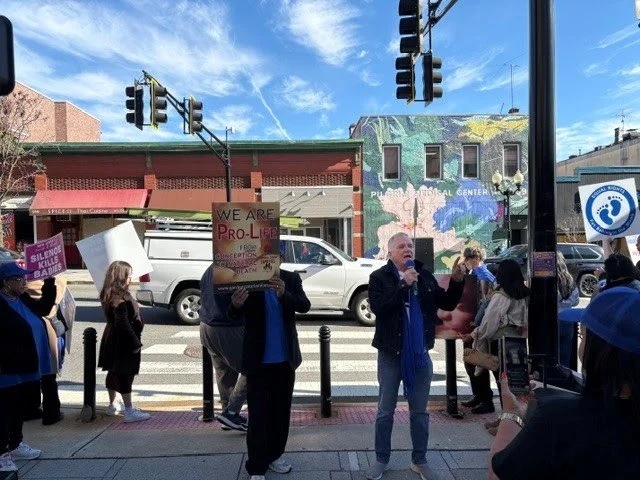
Rev. Gregory Quinlan Speaking at Free Speech Rally Montclair, NJ
Rev. Gregory Quinlan Speaking at Free Speech Rally Montclair NJ
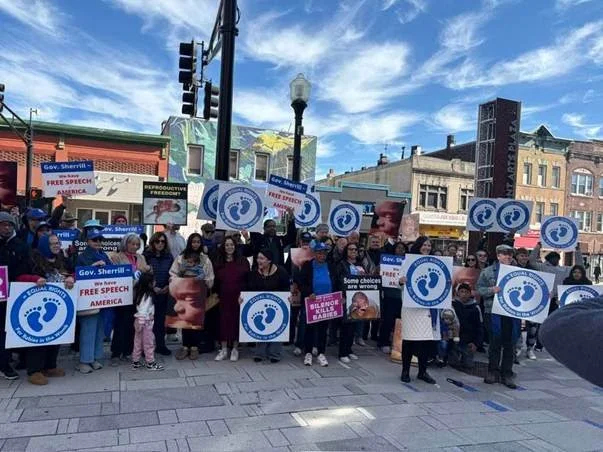
On October 24, pro-life organizations from across New Jersey gathered in Montclair, across the street from Pilgrim Medical Center, the Garden State’s second-largest abortion provider.
Christine Flaherty of LifeNet organized the event in response to S2260, which New Jersey Governor Mikie Sherrill signed into law with thunderous fanfare and applause. On August 20, 2026, the Governor held a highly publicized press conference at Pilgrim Medical Center to promote the legislation.
S2266 is blatantly unconstitutional! They know it, and we know it. Even after a Rutgers law professor publicly stated that this bill would never pass muster on its face, the legislature scrambled to make a few concessions. Those concessions are not enough. They know it, and we know it. We have secured several national public interest law firms willing to go to court as soon as our civil rights are violated under this law.
For our children, our future, and our nation, we will not be silenced\
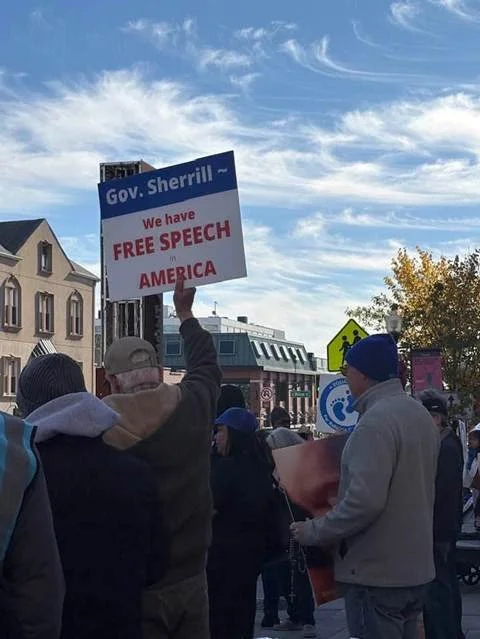
Free Speech Rally for Life: Silence Kills Babies.
On a Saturday morning for two hours, some came early, and some came late; some stayed for the entire time, totaling 97 people who were counted as exercising their free speech rights to protest abortion against New Jersey’s so-called new "face law.”
Christine Flaherty of LIFENET remarked: We have the right and the duty to try to save innocent children and their moms from the violence of abortion. The pro-life community must keep doing what we have always done: Exercising our freedom of speech guaranteed by the Constitution to save the lives of babies in the womb who have no one to speak for them but us. We still have our constitutionally guaranteed rights to free speech.
Reverend Clenard Childress of LEARN & Black Genocide spoke passionately about the disproportionate number of African American and minority children killed across the street at Pilgrim Medical Center.
Marie Tasy of New Jersey Right to Life spoke about the serious concerns surrounding New Jersey's recently enacted S2260, which Governor Sherrill signed into law at a nearby Planned Parenthood abortion facility. She emphasized the importance of protecting peaceful pro-life advocacy, including prayer, sidewalk counseling, and offering compassionate assistance and practical alternatives to women facing unexpected pregnancies. She also reaffirmed that pro-life advocates will not be intimidated into silence and will continue standing for the protection of human life and the rights of women and their babies.
Rev. Gregory Quinlan of the Center for Garden State Families emphasized that the bill is not just about abortion but also includes transgender chemical mutilation and irreversible surgical treatment and referrals given at Pilgrim Medical Center. “Governor Sherrill, by signing this bill, endorsed and encouraged the mutilation of children in the womb and children out of the womb, exploiting vulnerable human beings for the sake of a misguided political agenda.”
Other speakers included Bill & Barbara Eames of Working Together NJ, Lisa Hart of 40 Days for Life, and Alan Wright of New Jersey Family Policy Council.
What S2260 Does
S2260 creates a new criminal offense called “interference with reproductive health care services.” It also establishes a private civil cause of action and authorizes the Attorney General and local prosecutors to seek injunctions and impose civil fines.
The penalties are substantial:
Fourth-degree crime: Up to 18 months in prison and a fine of up to $10,000.
Third-degree crime: If someone suffers bodily injury, 3 to 5 years in prison and a fine of up to $15,000.
Second-degree crime: If someone suffers significant or serious bodily injury, 5 to 10 years in prison and a fine of up to $150,000.
Civil fines: Up to $10,000 for a first violation and $25,000 for each subsequent violation.
Private lawsuits: At least $1,000 in damages per violation, plus potential punitive damages and attorney fees.
Significantly, the law permits private civil lawsuits even without a criminal conviction.
The law applies to abortion facilities and, under its definition of “reproductive health care services,” also encompasses facilities providing gender-related medical interventions.
Although sponsors removed some of the original language that most explicitly targeted gatherings near clinic entrances, the final criminal provisions focus on bodily injury, physical obstruction of entry or exit, property damage, and intimidation, threats, or coercion through force or the threat of force. The law defines “intimidate” as placing someone in reasonable apprehension of bodily harm.
This is not an explicit ban on prayer. Nevertheless, it is a statute that prosecutors, clinics, or private plaintiffs may seek to apply broadly.
Why Peaceful People May Be Silenced
A law does not have to say, “Prayer is illegal,” to have the effect of emptying a sidewalk.
People of faith who stand outside abortion facilities engage in ordinary, lawful activities. They pray. They hold signs. They offer brochures, rides, hotline numbers, and words of hope. These are forms of speech and peaceful assembly protected by the First Amendment when exercised lawfully on public property.
Under S2260, questions about whether someone's presence “intimidated” another person, “obstructed” a walkway, or “interfered” with access could be raised by:
A clinic employee who wants the sidewalk cleared;
A prosecutor responding to a complaint;
A judge interpreting a new and untested statute; or
A private plaintiff seeking statutory damages and attorney fees.
When the consequences of a misunderstood conversation could include criminal charges or a five-figure lawsuit, many people may decide that the safest option is to stay home.
That is self-censorship.
The government does not have to win a case at trial if the threat of prosecution is enough to make ordinary Christians question whether offering a prayer or a word of encouragement is worth the risk of 18 months in prison and expensive legal fees.
The potential for civil liability adds another layer of concern. Even when a criminal prosecution fail, a clinic or private plaintiff could still file a lawsuit. Defending against such a lawsuit can be expensive. The statute's minimum damages and attorney-fee provisions create an additional financial burden for those who choose to exercise their First Amendment rights.
This is why Assemblyman Greg Myhre and other opponents warned that broad terms such as “intimidate” and “interfere” could be used against people of faith.
The First Amendment does not disappear simply because someone is standing on a public sidewalk near a particular building. S2260 places important questions about free speech and peaceful assembly before the courts—and raises concerns for every pastor, sidewalk counselor, and grandmother who may now wonder whether a prayer could be interpreted as a criminal offense.
THIS IS WHY YOU MUST TAKE ACTION NOW