
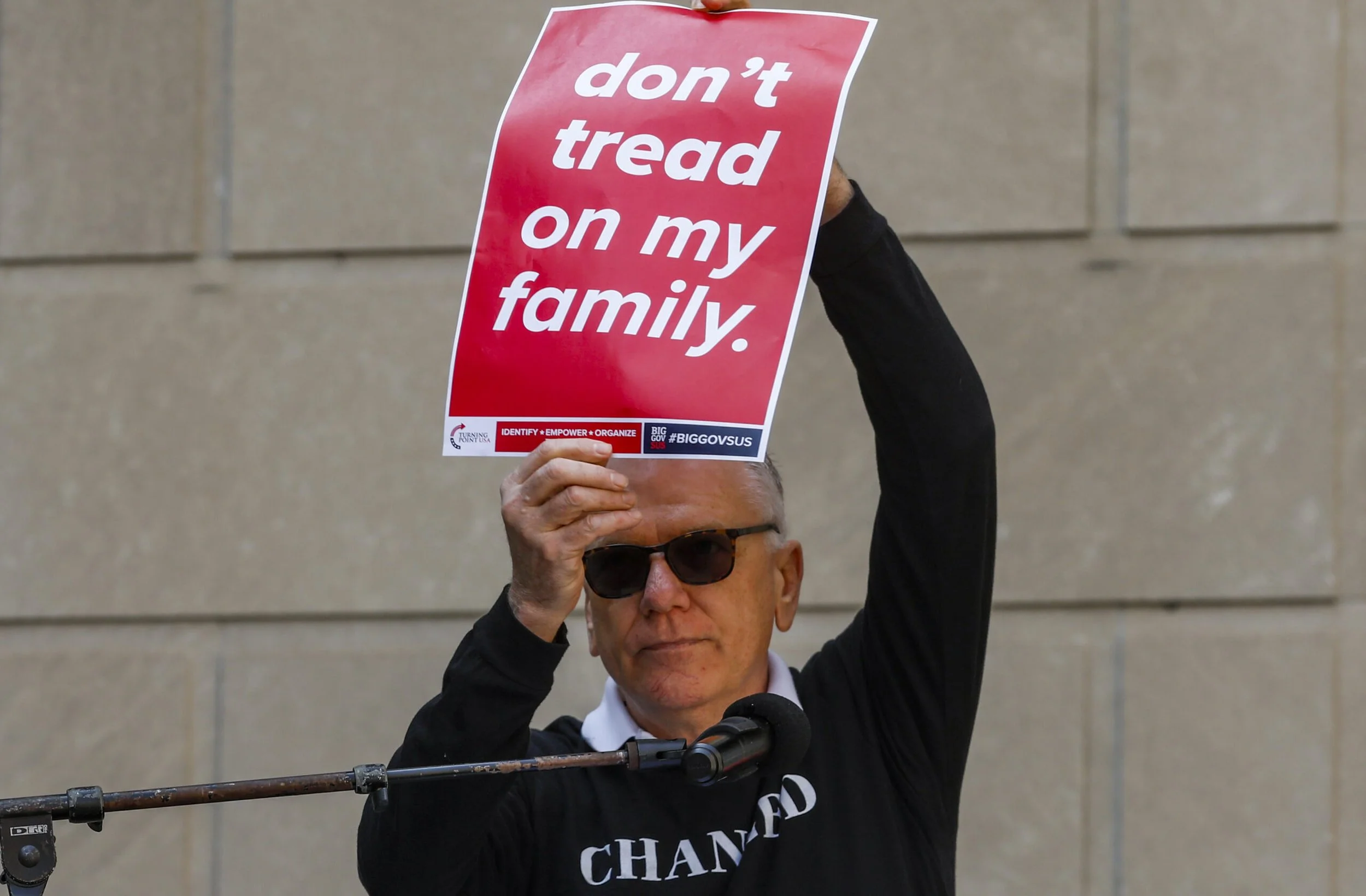
Gregory Quinlan of the Garden State Center for Families speaks out against a bill that supporting gender-affirming care for youth at a rally at the Statehouse in Trenton on May 15, 2023, for parental rights and against governmental interference. (Dana DiFilippo | New Jersey Monitor)
The above photo incorrectly and perhaps deliberately scrambled the Center for Garden State Families' name. Here is the link: https://newjerseymonitor.com/wp-content/uploads/2023/05/I7A9394_1-scaled.jpg
On April 28, 2026, the New Jersey law firm Murray-Nolan Berutti LLC filed a federal lawsuit in the U.S. District Court for the District of New Jersey that strikes at the heart of a long-running conflict: whether public schools can socially or otherwise “gender transition” minor children without notifying their fit parents or obtaining fully informed consent. The case, Lema v. Davenport (No. 2:26-cv-04682), names New Jersey Attorney General Jennifer Davenport, Acting Education Commissioner Lily Laux, and officials from five school districts—Hackensack, Burlington Township, North Hunterdon-Voorhees Regional, Bethlehem Township, and Newark.
The plaintiffs—Maria Lema, Robert Shull, Christopher Stadulis, Laurie Valenti, and Irma Nunez—seek a permanent injunction stopping the state and these districts from enforcing any law, guidance, or policy that allows schools to facilitate gender transitions of minors without parental notice and consent. They also ask the court to order districts that have already done so in secret to inform the parents. The firm has made clear it is prepared to take the case all the way to the U.S. Supreme Court if necessary. “We can never again allow public officials to crush Parents’ Rights. The Constitution and common sense must prevail at all times,” the filing and accompanying statements emphasize.
This is not an isolated legal skirmish. It builds on earlier litigation by the same firm, including a case involving a father whose daughter was socially transitioned at Delaware Valley Regional High School without his knowledge. New Jersey’s Department of Education guidance (commonly referenced as Policy 5756) has long directed schools to accept a student’s asserted gender identity without requiring parental consent or notification in most circumstances. State officials and advocates have defended the approach as protecting student privacy and complying with the New Jersey Law Against Discrimination. Parents and groups focused on family rights counter that it systematically excludes fit mothers and fathers from decisions that go to the core of child-rearing.
The Center for Garden State Families, a Christian family advocacy organization based in Parsippany, has long warned about precisely these dynamics. Founded to protect and promote faith, freedom, and the natural family—defined in traditional terms as one man, one woman, and their children—CGSF has repeatedly argued that policies enabling schools to keep gender-related changes secret from parents undermine both constitutional parental rights and the developmental needs of children. Its founder and president, Gregory Quinlan, has spoken at school board meetings and in public forums against Policy 5756, describing it as a “license to lie to a parent” that assumes parents are the problem rather than the primary protectors of their children’s well-being. CGSF’s work on education, parental rights, and opposition to what it views as ideological overreach in schools provides important context for why lawsuits like Lema keep emerging in New Jersey.
The Broader Pattern
Social transition—using preferred names and pronouns, treating a child according to a gender identity different from biological sex—is not a neutral administrative act. Multiple clinicians and researchers have described it as a psychosocial intervention that can solidify a temporary or socially influenced identity and set a child on a pathway toward medicalization. When schools do this without parents’ knowledge, they interfere with the family’s ability to seek appropriate mental-health evaluation, address co-occurring conditions (anxiety, depression, autism, trauma, or same-sex attraction), or simply give a child time and space to explore identity without irreversible steps.
New Jersey is not unique. Similar parental-notification fights have played out in California, New York, and elsewhere. A recent U.S. Supreme Court action involving California policy underscored the constitutional weight of parental rights in this area. Yet in New Jersey, state guidance and interpretations of anti-discrimination law have continued to tilt toward secrecy unless a narrow “compelling need” is shown. The result, according to the Lema plaintiffs and groups like the Center for Garden State Families, is a system in which schools can actively facilitate a child’s social transition while deliberately keeping parents in the dark.

The New HHS Report: “Wolves in White Coats”
Into this already charged landscape, a major new federal report is released by the U.S. Department of Health and Human Services in mid-August 2026. Titled Wolves in White Coats: How Doctors and Hospitals Pushed and Profited from the Fraud of “Gender Medicine,” the 64-page document (commissioned by HHS and drawing on claims data, whistleblower accounts, hospital records, and patient/parent testimony) examines how the medical system expanded pediatric “sex-rejecting” interventions—puberty blockers, cross-sex hormones, and surgeries—despite weak evidence of long-term benefit and clear risks of harm.
The report’s central findings are stark. Over 225 hospitals and health systems established pediatric gender programs by the early 2020s. Once a child enters the pipeline, the report argues, they become a “captive patient”: lifelong consumers of expensive drugs, monitoring, and potential surgeries. Lifetime costs for hormones alone can run tens of thousands of dollars; surgeries push the total far higher. Pediatrics, traditionally a lower-margin specialty, suddenly gained a durable revenue stream.
More troubling is the report’s examination of insurance coding. Analysis of nationwide claims data from roughly 2015–2025 identified approximately $50 million in claims for puberty blockers billed under the vague diagnostic code for “Endocrine Disorder, Unspecified” (E34.9). Nearly $11 million more involved patients ages 13–17 billed under the code for precocious puberty—even though many of these children did not meet the clinical criteria for that condition. The report documents presentations at professional conferences, statements by clinicians, and advocacy materials encouraging the use of these codes to secure coverage that might otherwise have been denied. Whistleblower accounts and hospital records further suggest that accurate diagnosis of gender dysphoria was sometimes sidelined in favor of codes more likely to be reimbursed.
HHS Secretary Robert F. Kennedy Jr. and Vice President JD Vance (as chair of the White House Task Force to Eliminate Fraud) responded by referring scores of hospitals and clinics identified in the report to the Department of Justice and the HHS Office of Inspector General for possible investigation of federal law violations. The report does not claim every provider acted with criminal intent, but it makes a strong case that financial incentives, ideological capture of professional societies, and prior federal encouragement under the previous administration combined to expand an experimental medical pathway for minors with insufficient scientific justification.
Why the Timing Matters for New Jersey
The HHS findings arrive while New Jersey parents are still fighting for the basic right to know what is happening to their children at school. Social transition in the classroom is often the first step toward the medical pathway the report scrutinizes. If schools can socially transition a child in secret, parents lose the chance to intervene before hormones or surgery become the next “affirming” recommendation. The Center for Garden State Families and similar groups have long argued that secrecy severs the protective bond between parent and child at precisely the moment when vulnerability is highest.
The Lema lawsuit does not ask courts to ban social transition outright. It asks them to restore the presumption that fit parents—not school counselors or administrators—should receive notice and the opportunity to consent or object. That is a modest demand rooted in longstanding constitutional doctrine: the right of parents to direct the care, custody, and upbringing of their children. When combined with the HHS report’s evidence that the broader medical system has, in many cases, prioritized ideology and revenue over rigorous evidence, the stakes become clearer.
Children experiencing gender distress deserve careful, individualized psychological care, not ideological capture by schools or a medical system that has turned healthy young people into lifelong patients. Parents deserve to be at the center of those decisions, not locked out by policy. The New Jersey lawsuit and the federal report together underscore a simple truth: when public institutions treat parents as obstacles rather than essential partners, both the Constitution and the well-being of children suffer. The courts, and ultimately the public, will decide whether that pattern continues.